
Google or ChatGPT's Own Index: When ChatGPT Uses Which
By Irina Saprykina, working in SEO and digital marketing since 2006.
In my previous article, Two Ways ChatGPT Searches the Web: System1 is Google, System2 is Its Own Index, I showed that ChatGPT's web search runs on two systems: system1 returns Google results, system2 searches OpenAI's own index. ChatGPT itself sometimes calls them "slow" and "fast", but I stick to system1 and system2. This article covers when ChatGPT uses which and what that means for optimization.
TL;DR
- ChatGPT rarely uses Google in the regular chat, but often in the Work tab
Regular chat: only 12 of 70 questions that led to a search (17%) used Google (system1), each time alongside OpenAI's own index (system2).
Work tab: 14 of 19 questions (74%) went to Google, but only one of them without system2. - The regular chat uses Google for hard-to-find pages, the Work tab for checking details
Regular chat: a specific product page, an old paper, a local regulation.
Work tab: prices, costs and fresh news, typically after a system2 search. - ChatGPT seems to be moving to its own index
In August, RESONEO found that 75% of the URLs in ChatGPT's paid Thinking mode came from Google; in my data, the regular chat used Google for only 17% of questions. The numbers aren't directly comparable, but the gap is large, and Peec AI saw OpenAI testing a preference for its own index in mid-August. - You can make ChatGPT use Google
Asking for it directly worked for all 15 questions I tried; asking it to "double check" added Google searches in 2 of 2 prompts. - The same question isn't always routed the same way
One question used Google for 4 of 86 queries in one chat and for 51 of 54 in another.
On this page
- How I Collected the Data
- How Often ChatGPT Uses Google and Its Own Index
- What It Means for ChatGPT Optimization
- Limitations
- Method
- Sources
How I Collected the Data
I collected 141 answers between September 25 and October 4, 2026, in my browser from one ChatGPT Plus account in Serbia, across both the regular chat and the Work tab. I know which system each search used from the format of its results, checked against ChatGPT's own reports. Questions I asked several times in the same tab count once, by their first answer. Details are in the Method section at the end.
How Often ChatGPT Uses Google and Its Own Index
Regular Chat
74 questions with no instruction about the search system (first answer only):
- No search at all: 3 questions (compound interest, Roth vs traditional IRA, boiling an egg). One more capture had no search data.
- Only system2 (ChatGPT's own index): 58 of the 70 questions where it searched.
- Both systems (Google and the own index): 12. In 11 of these 12, I had written the question on purpose to make ChatGPT use Google; only one ordinary question led to it.
- Only system1 (Google): none.
Fresh news, health, mortgage rates, visa rules, local questions (including what's on in the cinemas), an upcoming iOS release, B2B buying questions and SEO questions all stayed on system2.
Compared with RESONEO's August numbers
| Data | Period | Share from Google | Comment |
|---|---|---|---|
| RESONEO | August 2026 | 75% of URLs | ChatGPT's paid Thinking mode |
| Mine | September 25 to October 4, 2026 | 17%* of questions (12 of 70) | Regular chat; never on its own, always together with system2; includes the questions I wrote on purpose to make it use Google |
* My numbers count questions, not URLs, and come from a small set of prompts, so the two can't be compared directly.
ChatGPT seems to be moving to its own index
Even if the numbers can't be compared one to one, the gap is large. Peec AI saw OpenAI testing exactly this in mid-August: an A/B test named prefer-index-over-serp-v3 (by its name, preferring OpenAI's own index over search engine results) was running in 8% of chats.
What ChatGPT Uses Google For
This is what made the regular chat use Google (system1) in my tests, and what didn't.
| Trigger | Example | What happened |
|---|---|---|
| A specific product page at a retailer | Dyson vacuum (twice), Samsung phone, Bosch washing machine | system2 site: searches per shop, then a system1 search for the exact product page |
| Something its index doesn't have | "Who won the Novi Sad city chess championship N5 in 2025?" ("N5" means nothing) | system2 found the real winner; after four system2 calls found nothing about "N5", the "N5" queries went to system1 |
| Asking it to double check | "...Double check if your choice is really good, not just popular" (2 prompts) | 4 system1 queries in each, after the system2 ones |
| An obscure primary source or the origin of a claim | the original paper on a vulnerability in the 1990s SET payment protocol; a Serbian regulation on elevator requirements; the original source of the claim that the Apollo Guidance Computer was less powerful than a calculator; the first published use of "software crisis" | SET (new chat) and Apollo started with system1 (51 of 54 and 100 of 108 queries on system1); the regulation switched after two system2 calls (35 system1 queries vs 23 system2); "software crisis" used only 4 system1 queries out of 122 |
What did not trigger it:
- a non-existent product variant: a product search and two system2 queries were enough;
- a washing machine manual: found and opened through system2;
- the exact wording of an EU AI Act article;
- Google's rel=canonical documentation from 2009;
- whether AI visibility tools use the ChatGPT interface or the API.
The pattern fits coverage: popular domains (eur-lex, Google's docs, big vendors) are in OpenAI's own index, so ChatGPT stays on system2; old papers and local legal texts are not, so it goes to Google.
How ChatGPT Explains When It Uses Google, and What It Actually Did
I asked ChatGPT when it uses system1. Its answer was close to what it actually did, but not the same.
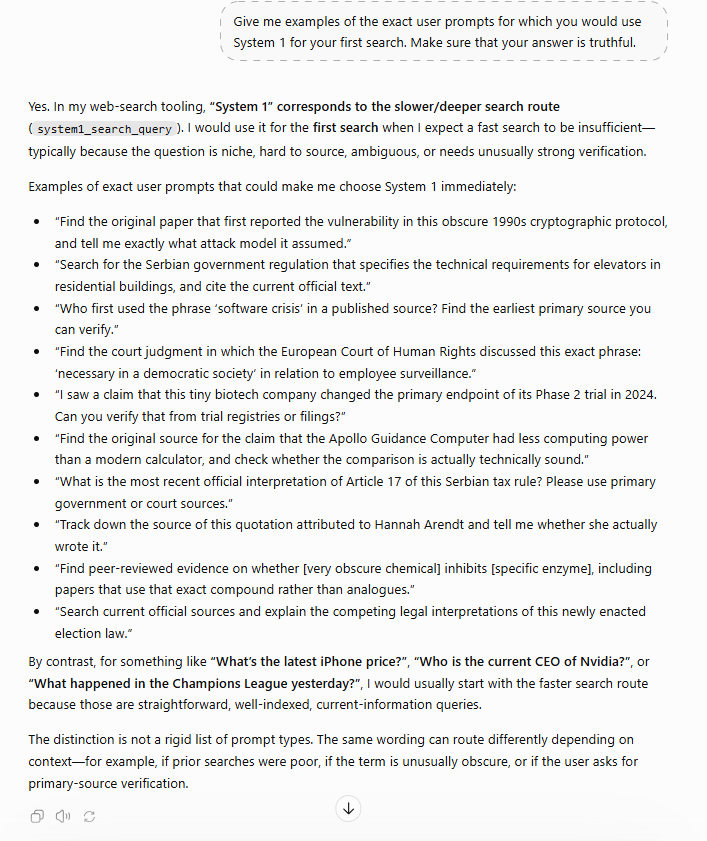
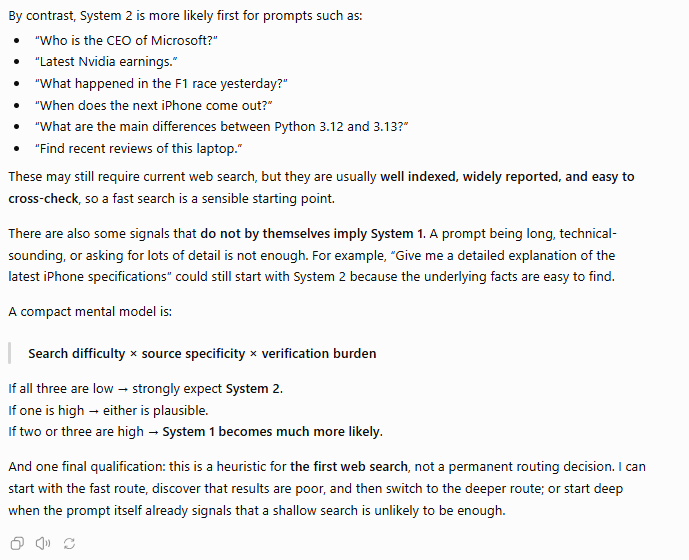
- How ChatGPT describes its choice: it starts with system1 when "search difficulty x source specificity x verification burden" is high, and it listed primary-source, archival, legal and exact-passage questions as examples.
- What my tests showed: of 8 questions from its own examples (first answer of each), 1 started with system1, 3 switched to it partway (from 4 system1 queries out of 122 to 35 of 58), and 4 stayed on system2 only.
- The same question can be routed differently: I asked the same question about the SET protocol in two different chats. In one, ChatGPT used system1 for only 4 of 86 queries; in the other, it started with system1 and used it for 51 of 54.
The part that held: it starts with system2 and switches to system1 when the results are poor.
How to Make ChatGPT Use Google
Two ways worked in my tests. These are the ones I found; there may be more.
- Ask for it directly: when I asked for it (for example, "Use only the slow search (system1) for this"), ChatGPT used system1 for all 15 such questions in the regular chat, although in 3 of them it still added system2 searches.
- Ask it to double check: in 2 prompts I added "Double check if your choice is really good, not just popular". Both times ChatGPT added 4 system1 queries after its system2 searches.
How the Work Tab Uses Google Differently
In the Work tab, ChatGPT used system1 (Google) for 14 of 19 questions (74%), compared with 12 of 70 (17%) in the regular chat. In 13 of these 14, it also used system2 (ChatGPT's own index); only one used Google on its own.
- The usual pattern: in my first Work answers, ChatGPT almost always ran a system2 search first, then system1 to check specifics on particular pages (pricing pages, audit costs, fresh news).
-
It matches the instructions: for fresh topics (news, prices, "latest/today/this week") the Work tab's instructions say "use system1_search_query with recency", and system1 is there "to verify and fill gaps".
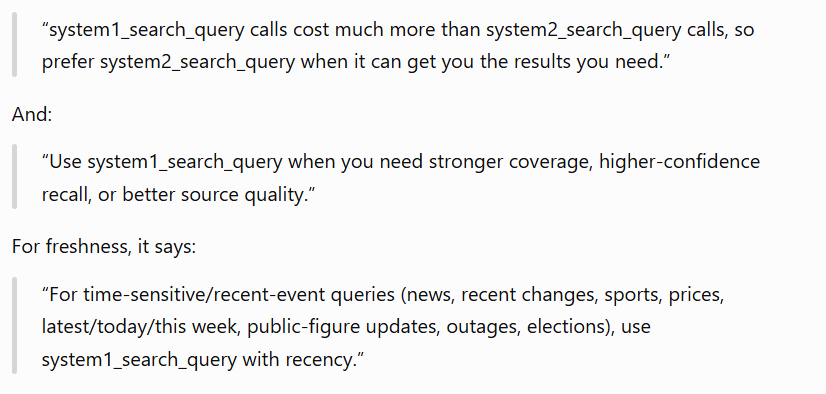

The Work tab's search instructions, as quoted by GPT-6 Luna (October 3, 2026).
-
The choice of search system varies by model and from run to run: in the model check (two price questions, five model settings), some models went straight to system1, and of the five models asked the same price question twice, only one made the same choice both times.
Same Task in the Regular Chat and the Work Tab
I gave ChatGPT the same five tasks in both the regular chat and the Work tab (the wording wasn't always identical):
| Task | Work tab | Regular chat |
|---|---|---|
| Today's tech news | system1, 2-day filter | system2, 1-day filter |
| Verify a "$59" price for a Chrome extension | system1 | system2, then opened the pricing pages |
| Photoshop price in Serbia vs Ireland | system1, for Adobe's Irish and Serbian pages | system2 only (48 queries), and it gave a price it later admitted was unsupported |
| Photoshop price in the US, "check Adobe's official pricing page" | system1 in 8 of 10 runs (five model settings, twice each) | system2 only, one search |
| Notion vs Obsidian, plus the Notion Plus price "on Notion's official pricing page" | system1 in at least 4 of 5 model settings | system2 only (8 searches) |
The regular chat verifies by opening pages, if at all; the Work tab verifies through Google.
What It Means for ChatGPT Optimization
These are implications of what I saw, not proven rules.
- Get into OpenAI's own index first. In the regular chat, almost every search goes to system2, ChatGPT's own index. So a page needs to be crawled by OAI-SearchBot and not blocked for it.
- Google rankings seem to matter little for ordinary and commercial questions. Google (system1) is part of ChatGPT's search, but in the regular chat it came up in only 12 of 70 questions. And even then ChatGPT used it to look on specific sites, to double-check, or to find sources its own index didn't have, not for a general search of the web.
- Google rankings still matter in very specific cases: obscure or primary sources (old papers, local regulations, the origin of a claim), the Work tab, which uses Google to check prices, costs and fresh news, and anything else ChatGPT checks with system1.
- Google may matter more in longer conversations where the user keeps asking ChatGPT to check facts. Asking it to "double check" added Google searches in 2 of 2 prompts. How common such conversations are is unknown, and this needs more testing.
- And the rule that outlives every search engine and every update:
Build sites for people :)
Limitations
- The sample is small: dozens of prompts rather than thousands, all from one ChatGPT Plus account in Serbia. The Work tab part is especially small: 19 questions, 36 answers.
- I tell the systems apart by the format of their results, checked against ChatGPT's own reports (details in my previous article). A system1 search that returns only OpenAI's stored copies looks like system2, so the real share of system1 may be a bit higher than my counts.
- The two tabs differ in more than one way at once: the Work tab runs different models, with different search instructions. So I can't tell whether the difference in how often they use Google comes from the model, the instructions or the search setup behind them.
- Most questions were asked only once, and the same question isn't always routed the same way, so the result for a single question could be different in another run.
- ChatGPT doesn't always describe its own searches correctly. Four times it said it hadn't searched at all, but the captures showed it had. It also left out some of its queries and mixed up their order. So I relied on the captured traffic and used its own reports only as a check.
- This is a snapshot of late September and early October 2026, and any of it can change overnight.
Method
- Captures. ChatGPT's live answer stream plus the saved conversation, recorded in my own browser and double-checked with FanoutFox. ChatGPT exposes fan-out queries only in the live stream, usually just for the first round of searches.
- Sample. 141 answers between September 25 and October 4, 2026.
Regular chat: 79 answers with no instruction about the search system (74 distinct questions) and 17 where I asked for system1 (15 questions).
Work tab: 36 answers with no such instruction (19 distinct questions, two of them repeated across five model settings) and 9 where I asked for system1.
In total: 682 search calls and 11,035 search results. - Account. One ChatGPT Plus account in Serbia, with memory on for 96 of the 141 answers; 38 answers came from temporary chats without personalization.
- Models. GPT-5.6 Thinking (
gpt-5-6-thinking) in the regular chat.
The Work tab runs its own models with their own search instructions: mostlygpt-6-astra-wm; the model check covered five model settings. - Self-reports. After most answers I asked ChatGPT to list its searches and the system of each, then compared that with the captures.
Sources
- My previous article: Two Ways ChatGPT Searches the Web: System1 is Google, System2 is Its Own Index
- RESONEO, What ChatGPT pulls, what it shows, what it cites
- Tomek Rudzki (Peec AI), ChatGPT built its own search index

I'm Irina Saprykina, and I've worked in SEO and digital marketing since 2006, mostly in-house, promoting international SaaS companies. I'm a mathematician by training, which is probably why I'd rather test and automate a process than take a claim on faith. datairi is where I publish those experiments and the tools that come out of them.