Where ChatGPT's Product Recommendations Come From
By Irina Saprykina, working in SEO and digital marketing since 2006.
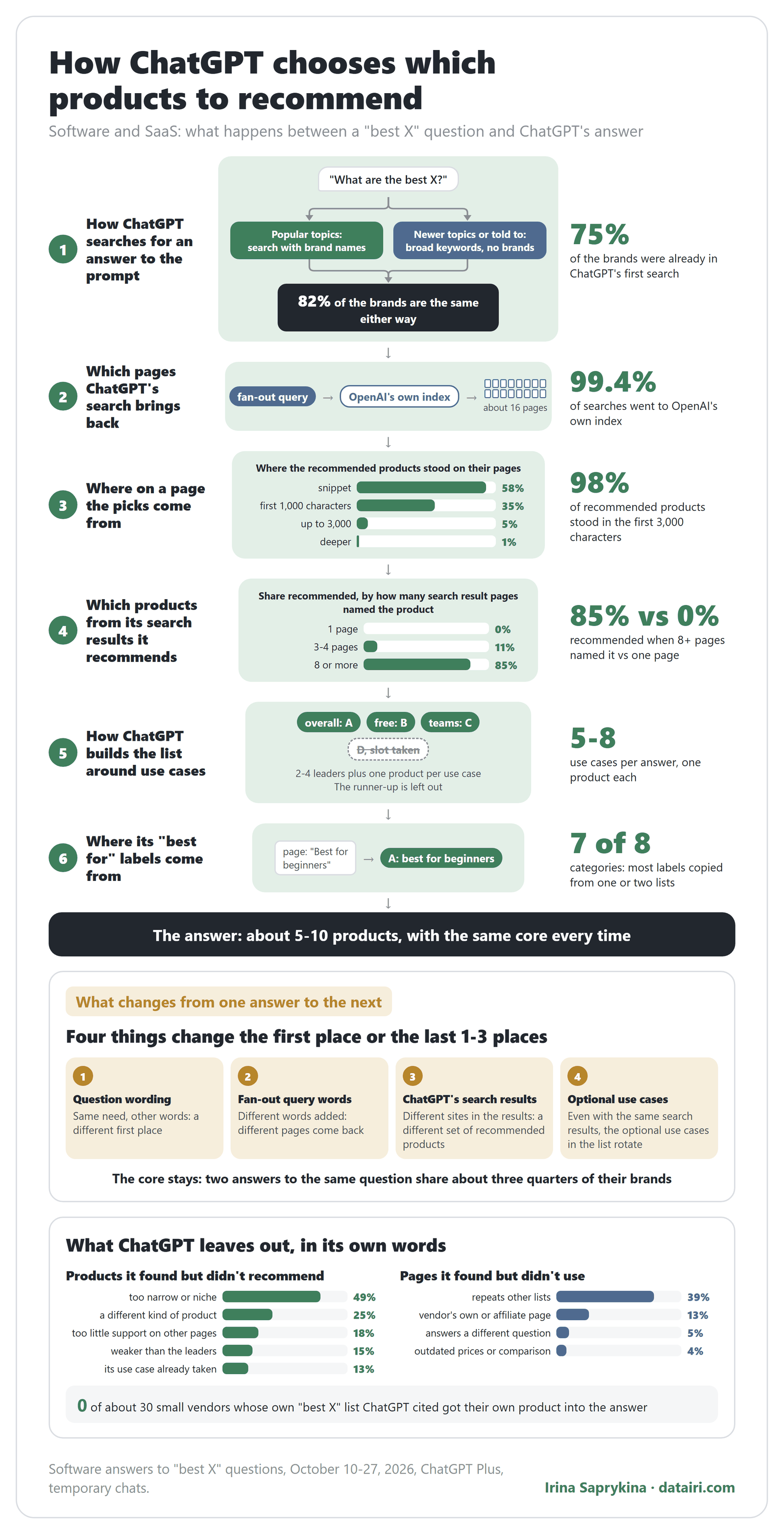
I studied how ChatGPT chooses the products it recommends when you ask a "best X" question, mainly for software, apps and online services. For popular software, it already knows most of the brands before it searches the web. But how did those brands get onto its list in the first place?
When I told ChatGPT to search without naming any brands, it ended up with almost the same products, picked from its search results alone. So the way it picks from its results is probably close to how its list formed. I reconstructed that process step by step, from 462 questions, and tested it: given ChatGPT's search results, can you predict what it will recommend? Mostly, yes.
TL;DR
- ChatGPT starts from the brands it already knows.
- For most "best software" and "best app" questions, ChatGPT puts the brands it already knows into its first search query: 75% of the brands in the answer were already there (78% with each question counted once).
- For newer topics, ChatGPT knows fewer products in advance and takes more of them from its search results: for new phones announced in October 2026, its first search named 0 of the 7 phones in its answer, and for AI video generators released in September 2026, about 1 in 3.
- Memory also weighs at the edge of the list: a video editor ChatGPT knows was in all 11 real answers although it was out of every list when the names were hidden, while a product it didn't know dropped down next to known names.
- Searching without brand names, ChatGPT picks almost the same products.
Told to search without naming any brands, ChatGPT ended up with almost the same list: 82% of the brands stayed across 29 software questions, no more change than between two answers to the same normal question. - ChatGPT writes its own search queries and runs them in OpenAI's own index; their wording decides what comes back.
- Only 6 of about 980 of these searches returned results that looked like Google's.
- ChatGPT's results are fresher than Google's top 10: on the same 15 software questions, the "best X" pages ChatGPT found were a median 63 days old, against 95 days in Google. The pages ChatGPT cited in its answers were even fresher, 29 days.
- A few extra words ChatGPT added to its own query brought in different pages.
- When the question doesn't say who needs the product or for what, ChatGPT fills in the most typical buyer and need itself and adds them to its queries: "small business" and "ecommerce" for email marketing software, "university professional skills" for online course platforms.
- ChatGPT sees more of a page than the stored snippet, but picks from the top of the page.
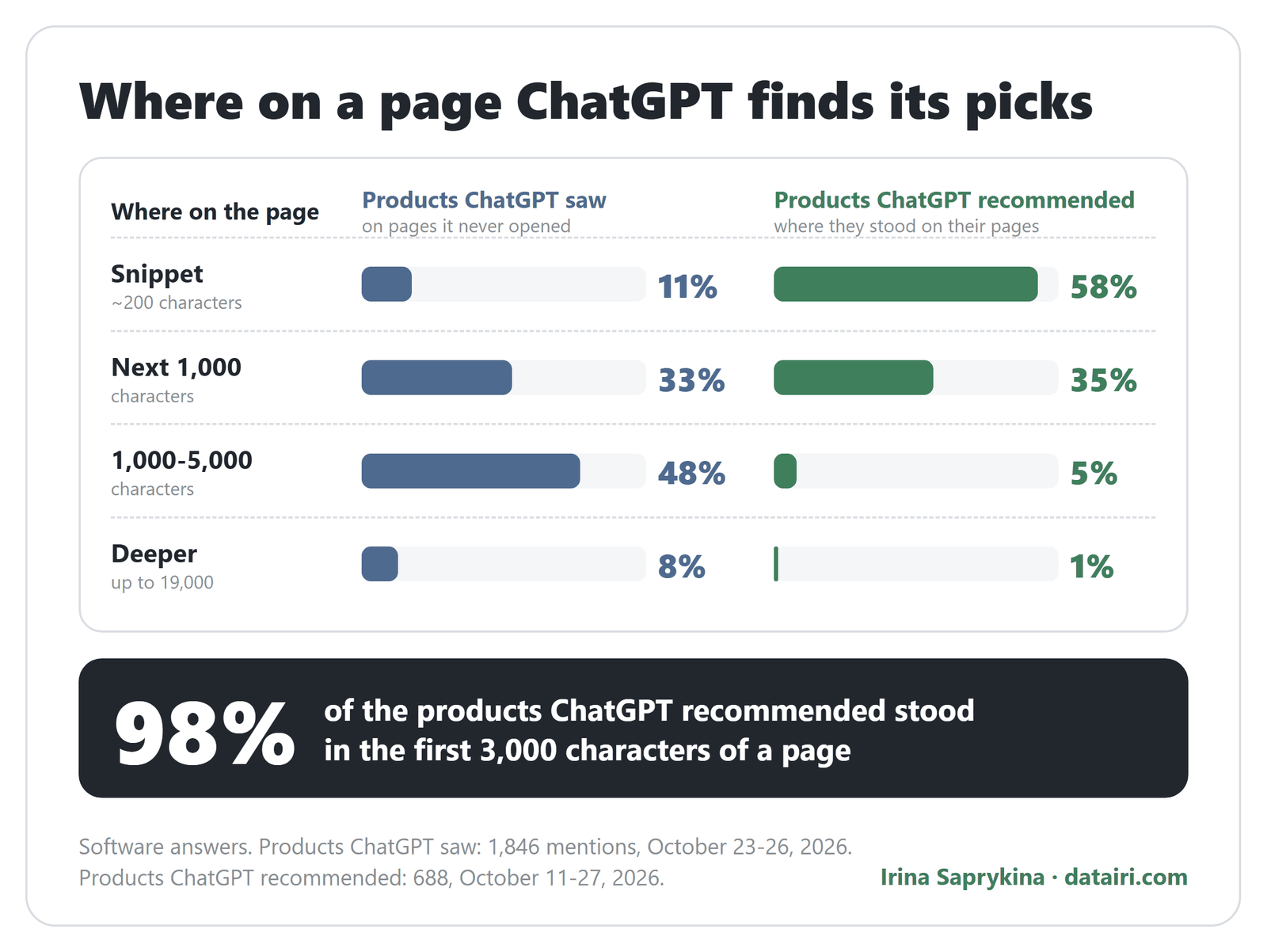
- On pages it never opened, it named products up to 19,000 characters into the article text.
- Yet 98% of the 688 software products it picked from its search results stood within the first 3,000 characters of a result page.
- ChatGPT recommends the products most of its search results agree on.
- According to ChatGPT's own tables in 50 repeated answers about software, a product named by 8 or more results was picked 85% of the time, a product named by only one result never (0 of 1,677).
- How many results named a product mattered far more than how high in the results it appeared.
- In narrow niches, pages from sites with a Domain Rating close to 0 shaped the picks as much as pages from big sites.
- ChatGPT gives each use case to one product.
- Each category has a fixed menu of use cases, such as e-commerce, a budget pick or advanced automation in email marketing, and mostly the same product holds each one.
- A product can get into the list on the strength of a single page when that page gives it a verdict no other page has, such as a hands-on test's pick for one use case.
- The runner-up for a place that is already taken is left out.
- ChatGPT labels its picks with the pages' own words.
- In 7 of 8 categories, most "best for" labels were copied or lightly reworded from one or two lists near the top of its results.
- ChatGPT leaves out products too narrow for a general answer, a vendor's own product on its own list, and pages that only repeat other lists.
- Of about 30 small vendors whose list ChatGPT cited, none got its own product into the answer.
- ChatGPT noticed when a site sells ranking places and gave its ranking less weight, but a product such sites put first for money still got into its answers.
- The core of ChatGPT's list stays the same from answer to answer, while the last places change.
- Two answers to the same software question shared about three quarters of their brands.
- The last places change because ChatGPT adds different words to its query, its search results change from day to day, a product that rests on a single page's verdict comes and goes with that page, and ChatGPT rotates the optional use cases.
- ChatGPT's picks can be predicted from its own search results better than from Google's.
- Before asking, I predicted from ChatGPT's own search results which products it would recommend in 3 new software categories, and every product I predicted as certain was in all 29 of its answers.
- Google's top "best X" articles caught only 58% of its software picks, at most 65-66% with pages from the last 3-6 months.
- Outside software, hardware works differently (fewer questions).
- The first search names testers such as RTINGS and Wirecutter instead of products.
- The testers' current picks predicted all 13 brands ChatGPT recommended in 5 hardware categories.
The findings come from 462 "best X" questions asked from October 10 to 27, 2026, almost all on one ChatGPT Plus account in temporary, unpersonalized chats. For each answer I saved what ChatGPT searched and what its searches returned, and checked its claims against the pages (data and method).
More: What It Means for Getting Recommended by ChatGPT · How Sure These Findings Are · Method
Stage 1: How ChatGPT Searches for an Answer to the Prompt
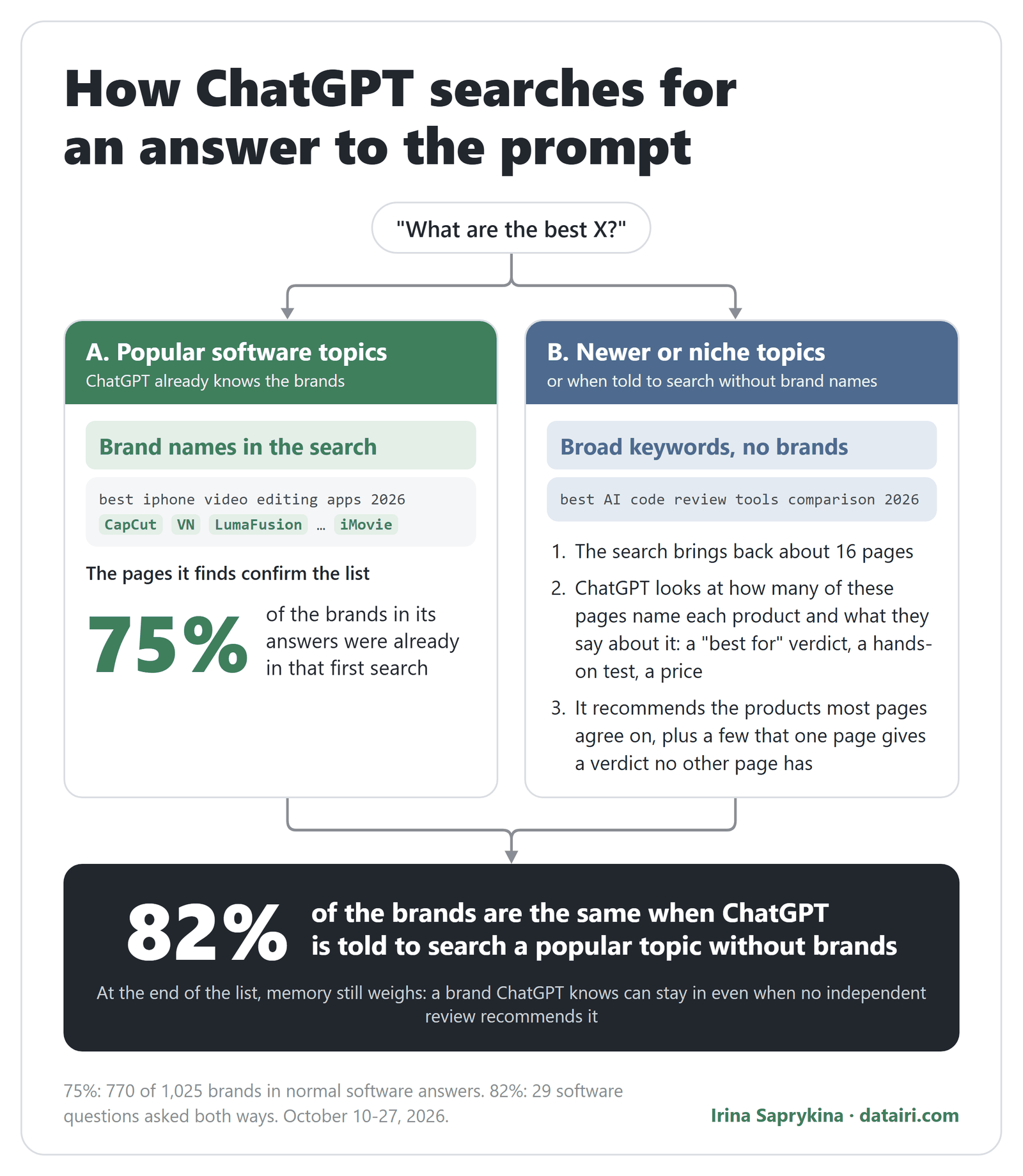
ChatGPT searches by one of two routes, and both end at almost the same list: it either searches for the brands it already knows, or, for newer topics or when told to search without brand names, it runs a broad search and takes the products from the results. Its memory of the brands still weighs on the result at the edge of the list.
Searching for the Brands It Already Knows
For popular software, most of the brands ChatGPT recommends are already in its first search query. Across all software questions asked normally from October 10 to 27, 770 of 1,025 brands in the answers (75%) were already in the first search. Some questions were asked many times, so counted with each of the 81 questions once, the share is 78%. The questions after the first week alone gave the same picture (76%). Questions phrased as a need ("I need an app to edit videos on my iPhone") behaved the same.
A typical first search is already a list of brands. Asked "What are the best video editors for the iPhone?", ChatGPT sent two queries together:
best iphone video editing apps 2026 CapCut VN LumaFusion DaVinci Resolve iPhone iMovie pricing
Apple iMovie iPhone App Store LumaFusion VN Video Editor CapCut InShot 2026
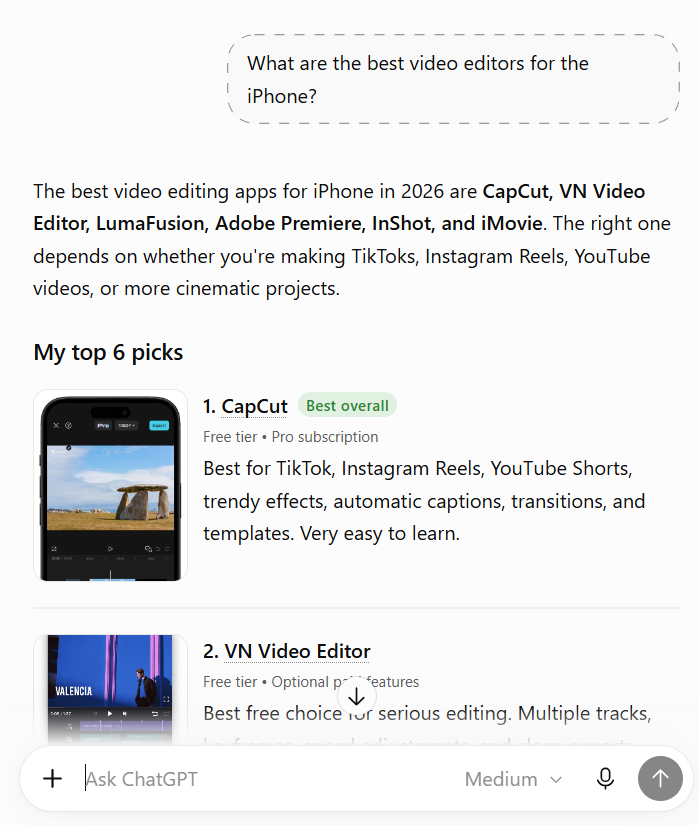
Five of the six apps in its answer were in these queries. Asked how it had chosen the app names before seeing any results, ChatGPT said it "identified well-known video editing apps from information learned during training" and then searched to verify them. It even named the risk itself:
This introduces a potential selection bias: searching for brands I already know can reinforce their prominence while overlooking newer or less familiar competitors.
When ChatGPT starts from brands it already knows, it relies on a result page that lists the same brands, even if that page is far down its search results. For Amazon seller tools, ChatGPT's first query listed the brands ("best Amazon product research tools 2026 Jungle Scout Helium 10 … Viral Launch SellerApp SmartScout Keepa"), and it took 8 of the 10 products from a small site's list, which was result #15 of 20.
ChatGPT can check the brands' own pricing pages already in its first search. In all 12 plain questions about CRM, video editing, AI presentation makers and online course platforms, the first search named the top of ChatGPT's list from memory and, in the same search, asked for those brands' official pricing pages, for example "best CRM software 2026 HubSpot Salesforce Pipedrive Zoho CRM pricing reviews" together with "site:hubspot.com/pricing/sales sales hub pricing 2026".
ChatGPT can only name brands before searching where it already knows the category. For newer topics, it knew fewer products in advance and took more of them from its search results: for new phones announced in October 2026, its first search named 0 of the 7 phones in its answer, and for AI video generators released in September 2026, about 1 in 3; the rest of its first queries were generic or named older products.
Searching Without Brand Names, ChatGPT Picks Almost the Same Products
To see whether ChatGPT needs its memory to build the list, I added to the question: "Before naming any products, search the web with a broad query without product names, and choose only from what you find." ChatGPT followed the instruction, so no first query named a product, but the lists hardly changed:
- Searching without brand names, ChatGPT kept most of the brands of its normal answer. Across 29 software questions asked both ways between October 10 and 27, the answers had about 7 brands each, and on average 82% of the brands in the normal answer were also in the answer without brand names. Comparing the answer without brand names with the normal one, no brands were missing in 7 questions, 1 brand in 13, 2 in 7, 3 in one and 4 in one (averaged and rounded where a question was asked several times).
- Searching without brand names changed the list no more than asking the same question again. I asked 20 of these questions normally at least twice. Two normal answers to the same question differed at least as much as a normal answer and an answer without brand names: on average, 1.4 brands of the first normal answer were missing from the second, and 1.2 from the answer without brand names.
- Without brand names in the search, the list changed most for AI coding tools, a category that changes fast. For AI code review tools, about 2 of 8 brands changed, and a little over half of all the brands in either answer were shared. This probably means that in fast-changing categories, ChatGPT's memory and the "best of" pages agree less, so it matters more whether ChatGPT starts from memory or from a broad search.
How ChatGPT's Memory of Brands Weighs Against the Pages
In 6 software categories, the top 4 products ChatGPT named from memory were in every answer. In each category, I first asked ChatGPT without searching which products it would recommend. The top 4 of that list were in all 62 answers that then searched. Beyond these top products, memory still mattered at the end of the list.
A brand ChatGPT knows can stay in the list even when no independent review recommends it. To see what memory adds beyond the pages, I gave ChatGPT the result pages of five categories with every product name replaced by a code and asked it to recommend from those pages alone (how it worked). Filmora, a video editor ChatGPT knows well, was out of all 4 coded lists ("no independent editorial guide recommends it"), yet in all 11 real answers. Its name made the difference.
Next to well-known names, a product ChatGPT doesn't know drops down the list. ACDSee Luxea is a free video editor that TechRadar picks for beginners, and it was not in ChatGPT's list from memory. With all names coded, ChatGPT kept it in every list; once the real names of the other products were shown, it fell to the end of the list or out. ChatGPT explained the drop by weaker support from the pages, never by the name. The two products side by side (1-4 runs per line):
| What ChatGPT saw | Filmora (6th in ChatGPT's list from memory) | ACDSee Luxea (not in ChatGPT's list from memory) |
|---|---|---|
| All names coded | Out in 4 of 4 | In 4 of 4, 6th-8th |
| All names coded, only this product named | In 2 of 2 (#9 and #12) | In 4 of 4, 10th-12th |
| All real names, only this product coded | Out in 2 of 2 | In once (#12), out once |
| All real names | In (#11) | Out |
| Real answers | In 11 of 11, 5th every time | In 0 of 11 |
Memory can even decide what the question means. "Online course platforms" can mean sites for taking courses, such as Coursera, or software for creating and selling courses, such as Teachable. In this category, ChatGPT followed the meaning from its memory, although most of the pages it found were about the other one (a single observation for now):
- Memory: asked three times without searching, ChatGPT listed only sites for taking courses, the same five in the same order: Coursera, Udemy, edX, LinkedIn Learning, Skillshare.
- Pages: 8 of the 11 pages that the fixed query "best online course platforms 2026" returned were about software for selling courses.
- Answers: all 11 put sites for taking courses first and called Coursera "best overall". Some added the software for selling courses as a second section, and there the pages decided as usual: Thinkific, ranked first by two of the pages, came first in all 7 such sections.
- Searches: told to search without product names, ChatGPT still searched in the learning sense: "best online learning course platforms comparison 2026 university professional skills creative courses".
Stage 2: Which Pages ChatGPT's Search Brings Back
ChatGPT writes its own search queries, and the pages they bring back are the pool it chooses from in the later stages. Two things shape that pool: the index the search runs in, and the words ChatGPT puts into its queries.
ChatGPT Searches OpenAI's Own Index, Not Google
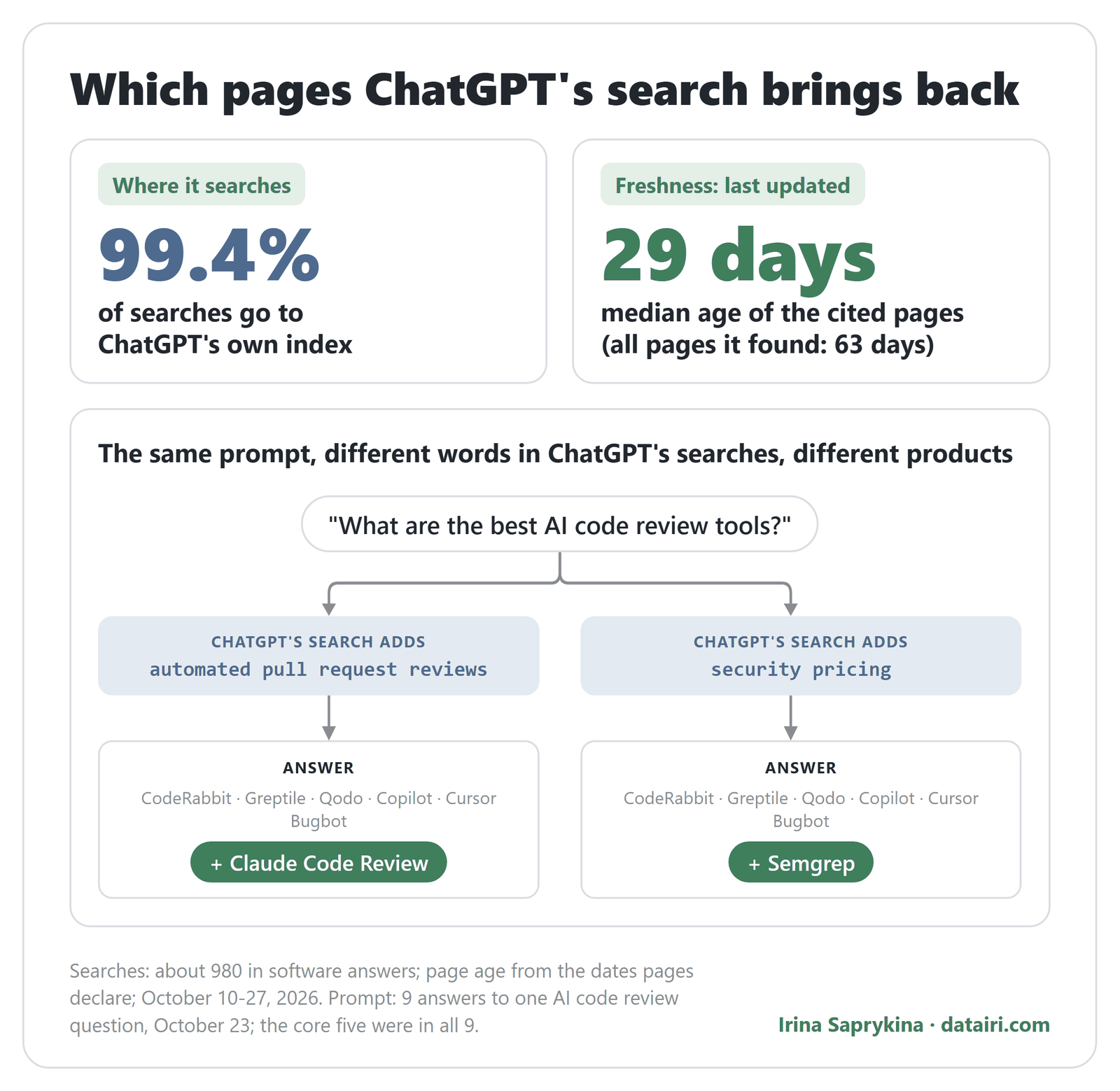
The search queries ChatGPT writes for itself, its fan-out, run in OpenAI's own index almost every time, not in Google. Of about 980 searches, only 6 (0.6%) returned results that looked like Google's. How to tell the two apart is in my earlier article, and when ChatGPT does turn to Google is in another one. So a page's Google ranking does not tell you where it stands in ChatGPT's results.
ChatGPT's search results are fresher than Google's top 10, and from those results it cites mostly the newer pages. For the 15 software questions I also checked in Google, the "best X" pages in ChatGPT's results were a median 63 days old, against 95 days for Google's top 10, and the pages it cited were a median 29 days old. Across all software questions, 48% of the dated "best X" pages in its results had been published or updated in the last month. These are the dates the pages declare themselves, and many sites refresh them without changing the list.
The Words ChatGPT Adds to Its Query Decide Which Pages Come Back
A few extra words in ChatGPT's query decide which pages fill the last places of the list. I asked "What are the best AI code review tools?" 9 times, each time telling ChatGPT to search without product names. Its query always started with the same words, "best AI code review tools comparison 2026", but the words it added differed, and they brought in different pages:
- "Automated pull request reviews": a list of pull request automation tools came up, and its #1, Claude Code Review, was picked every time that page was among the results.
- "Security pricing": a page about security scanners came up, and only that answer picked Semgrep, a security scanner.
The core of the list stayed the same in all 9 answers: CodeRabbit, Greptile, Qodo, GitHub Copilot and Cursor Bugbot.
A product can drop out when ChatGPT's own words bring different pages, even if many pages still name it. With the fixed query "best email marketing software 2026", the first result was TechRadar's guide, which names Mailchimp the best overall, and Mailchimp was in all 10 answers. When ChatGPT wrote its own query, it always added "small business" and "ecommerce", and lists for small businesses came up instead: TechRadar's guide appeared in only 3 of 8 searches, far down at #13. Mailchimp was still named by five or more of the result pages, but it was in none of the 8 answers, and MailerLite, a common small-business pick, came first in all 8.
A question that names no buyer is searched and answered for the most typical buyer. For business software, that was a small business. I asked about social media management tools with no audience, for a small business and for a large enterprise team. With no audience, ChatGPT searched and answered as for the small business, and first place went to small-business favourites, Buffer or Metricool ("My top recommendation for most small businesses is Metricool"). The enterprise answers put Sprinklr first every time, a tool that was not in the answers without an audience at all. Asked without searching, ChatGPT said a CRM question without requirements is answered for "a small business with roughly 1-20 users".
Stage 3: Where on a Page ChatGPT Finds Its Picks
ChatGPT gets much more of a page from OpenAI's index than the short snippet its conversation data keeps, even without opening the page. Yet the products it recommends come from the top of the pages.
ChatGPT Sees Far Below the Snippet
On pages it never opened, ChatGPT named products far below the ~200-character snippet its conversation data keeps. In 50 software answers I asked ChatGPT to list, for every product it found, all the search results that named it. On the pages it never opened, most of these products first appear well below the snippet:
| Where the product first appears on the page | Mentions (1,846) |
|---|---|
| In the stored snippet | 195 (11%) |
| Up to 1,000 characters below the snippet | 615 (33%) |
| 1,000-5,000 characters below | 895 (48%) |
| More than 5,000 characters below | 141 (8%) |
On one page it never opened, a list of 8 Amazon seller tools, ChatGPT correctly named the tools in places #4 to #8, which first appear 10,800-18,900 characters into the article. So the model gets at least an outline of the whole list, not just its top.
ChatGPT Picks from the Top of the Page
Still, 98% of the products ChatGPT recommended stood in the first 3,000 characters of a page. In 93 software answers where I told ChatGPT to search without product names (October 11 to 27), it recommended 688 products: 58% were already in a stored snippet, 35% elsewhere in the first 1,000 characters of the page, 5% in the first 3,000, and only 9 products deeper.
A likely reason: "best X" pages put their main picks at the top. For embedded form builders, ChatGPT recommended exactly the four tools that one vendor's page named in its short answer at the top and as #1 to #4 of its list; the vendor's own product, #5, was not recommended.
Stage 4: Which Products from Its Search Results ChatGPT Recommends
ChatGPT recommends the products that most of its search results agree on. A higher place in the results or a bigger site doesn't decide on its own, and a single page's verdict can add a product at the end of the list.
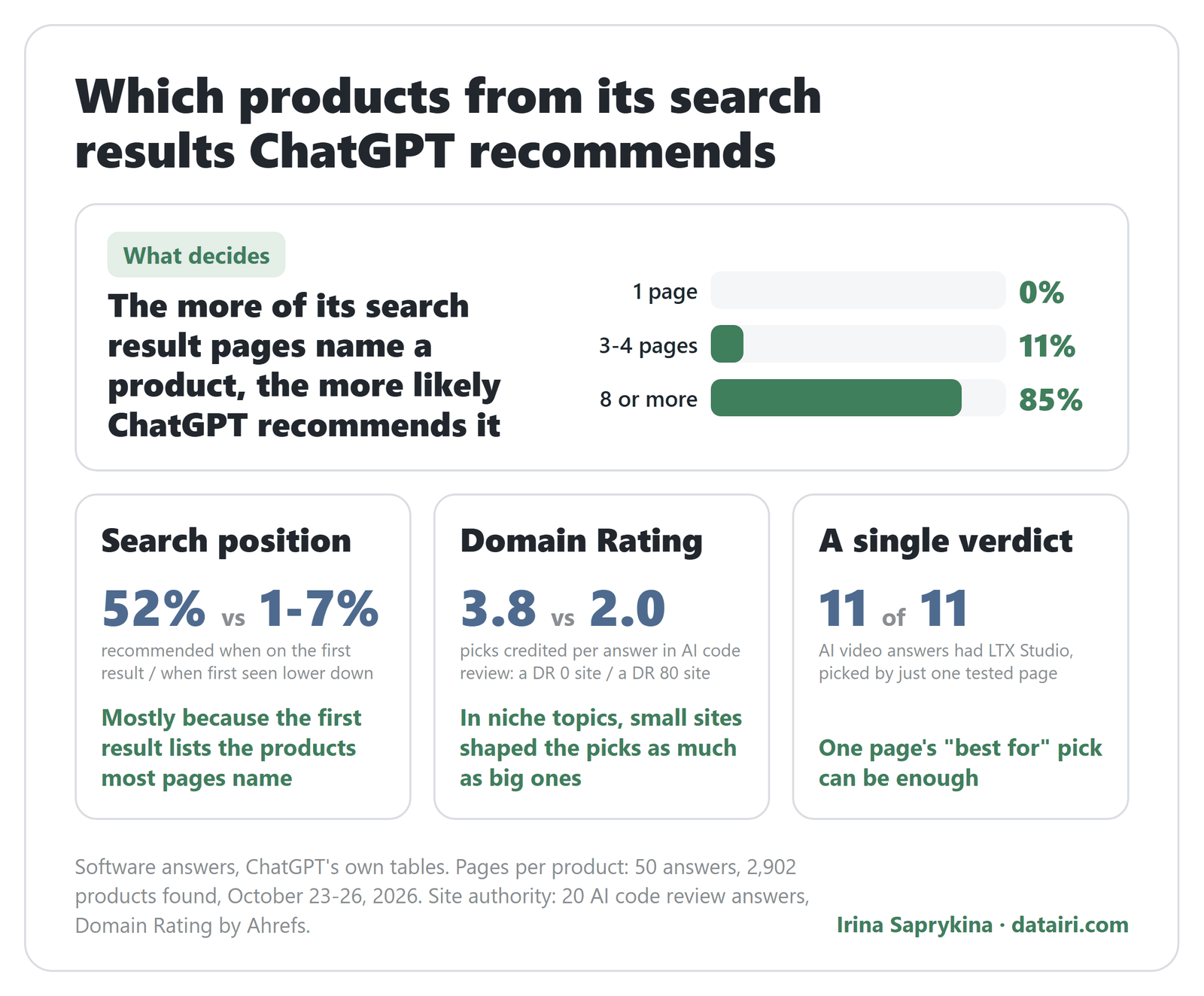
The more of ChatGPT's search results name a product, the more likely it is picked. In repeats of three software categories (AI code review, email marketing, AI video generators), I asked ChatGPT for every result that named each recommended product, and for every product found but not picked, with the results that named it. In 50 answers, ChatGPT listed 2,902 products it had found and picked 377 of them:
| Results that named the product | Picked |
|---|---|
| 1 | 0% |
| 2 | 4% |
| 3-4 | 11% |
| 5-7 | 36% |
| 8 or more | 85% |
A high place in ChatGPT's search results helped a product much less than being named by many results. Products on the first result were picked more often (52%, against 1-7% for products that first appeared lower), largely because the first result usually lists the products that many other pages name too. Among products named by the same number of results, those in the top three results were picked equally often when 2 results named them, somewhat more often when 3-4 did, and less often when 5 or more did:
| Results that named the product | Picked, if in the top 3 results | Picked, if first on result #4 or lower |
|---|---|---|
| 1 | 0% | 0% |
| 2 | 4% | 4% |
| 3-4 | 12% | 5% |
| 5 or more | 55% | 88% (33 products) |
The number of pages naming a product decides the top of ChatGPT's recommendation list, but not its last places. In 20 answers about AI code review tools, the tools at the top of every list were named by 9-11 of about 11 sites. The tools in the last places were named by only 2-5 sites, and more mentions did not help: SonarQube, named by 2-3 sites, got the static-analysis place over DeepSource and CodeAnt, named by 4-5. Other categories showed the same. What got a tool one of the last places was a page that named it the pick for a use case (stage 5).
Different kinds of pages played different roles in ChatGPT's picks. In 20 answers about AI code review tools:
- Rankings that agree make the leader: CodeRabbit came first in every answer because many rankings put it near the top.
- A test with numbers moves a product up: Qodo and Bito got in on a test with planted bugs.
- A page's pick for one use case fills a last place: SonarQube, PR-Agent and Snyk Code each got in this way.
- Big directories only supply candidates: two directories with 47 and 55 tools were used to find products, not to choose them.
A high Domain Rating did not make a page more likely to be cited; in narrow niches, small sites shaped the picks. Across all categories, pages from small and big sites were cited about equally often: of the 3,224 search results from sites other than the vendors', ChatGPT cited 12-16% in every Domain Rating band, from DR 0-9 to DR 70 and above. Which pages ChatGPT used for its picks depended on the category. In broad categories with many big sites, such as email marketing and project management, the pages behind the picks came from bigger sites than the unused ones.
In several narrower niches, I saw sites with a Domain Rating of 0 or close to it shape ChatGPT's picks. One of them, rated 0.1, was among ChatGPT's search results in all 20 answers to one question and was named as the reason for a pick 61 times. By Ahrefs' figures on October 30, it gets about 32 visits a month from Google, yet 382 ChatGPT responses cite its pages.
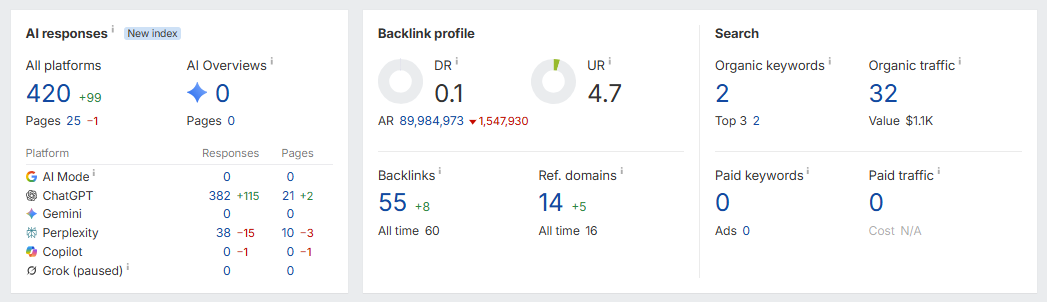
This is about which pages shaped the picks once they were among ChatGPT's search results, not about which sites get there.
Stage 5: How ChatGPT Builds Its Recommendation List Around Use Cases
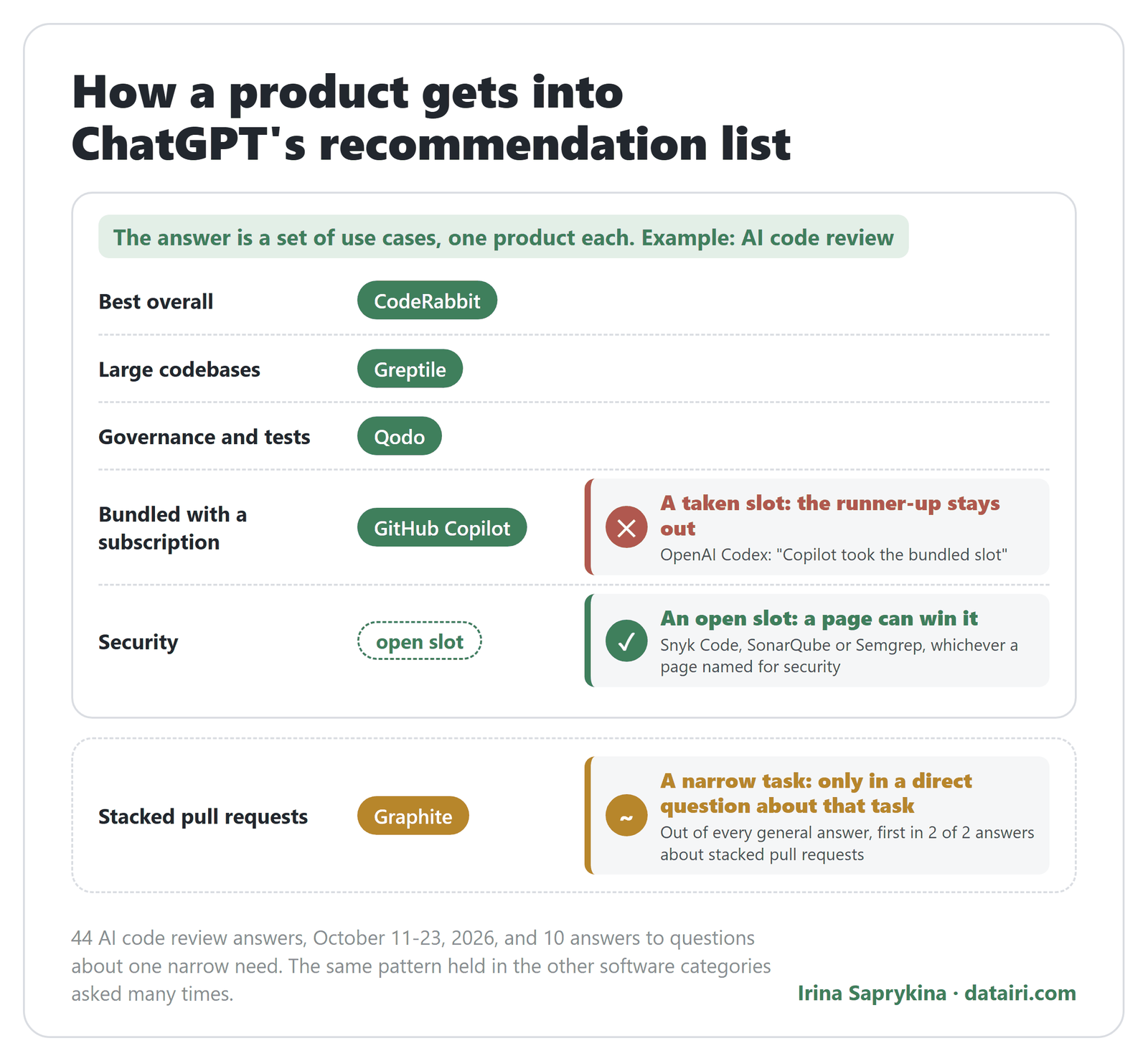
ChatGPT's recommendation list usually has 2-4 general leaders plus one product per use case, such as a free option, Apple users, e-commerce or small teams, and stops at about 5-10 products. ChatGPT itself describes the list as a set of use-case slots, and the slots behaved the same way in every software category I asked about many times.
For example, in 11 repeats of one AI code review question:
- Each slot had one winner, and it never changed: "SonarQube won my static-analysis slot", "Copilot took the bundled slot".
- The runner-up was left out because its slot was taken: OpenAI Codex was in the "not picked" list of all 11 answers.
- What changed between answers was which optional slots made it into the list: static analysis, security, Cursor users or a budget pick.
Each category has a fixed menu of use cases, and mostly the same product holds each one. For example, in 22 email marketing answers from October 10 to 23, ChatGPT drew on the same menu. The counts are out of the answers that had each use case:
| Use case | Product that held it |
|---|---|
| E-commerce | Klaviyo (16 times; Omnisend 5) |
| Budget or free plan | Brevo (13 of 15) |
| Advanced automation | ActiveCampaign (13 of 15) |
| Small businesses | MailerLite (11 of 15) |
| B2B and CRM | HubSpot |
| Creators and newsletters | Kit |
| All-in-one marketing | Mailchimp (5 times) |
Project management and the other categories I asked about many times showed the same.
A new product rarely takes a use case from the product that holds it; it gets into the recommendations by owning a need that no product holds yet. In AI code review, for example, almost every use case went to the same product in 44 answers over two weeks: Greptile for large codebases in 39 of 41 answers, Claude Code Review for deep reviews of high-risk changes in 17 of 17. Security was the only use case without a fixed holder, and there Snyk Code, SonarQube and Semgrep took turns, each brought in by a page that named it for security.
A single page can win a place for a product when it gives a verdict no other page has. The products that one page alone brought in were mostly not from the top results, but from pages with a verdict of their own:
- A hands-on test that picks a product for a use case no other product holds. LTX Studio got into all 11 AI video generator answers only because Zapier, which tested the tools, picked it for shot-by-shot storyboarding; ChatGPT called it "a search-driven inclusion", with no second page giving it that verdict. Kdenlive got the free open-source place among video editors from Zapier's tested list, and GenSpark got into all 5 fixed-query answers about AI presentation makers from one tested page, although it was not in ChatGPT's list from memory at all.
- User review ratings with numbers. Bigin and Less Annoying CRM got into 6 of 11 CRM answers each from one page, Capterra's rating analysis, and the answers quoted the ratings.
- A test that measures the products. TechnBrains tested AI code review tools on one pull request with four planted bugs and reported that Qodo, Claude Code and Bito found all four, while CodeRabbit and Greptile found three. ChatGPT quoted this test in all 11 fixed-query answers and called the page "one of the most influential" results. The test was the main reason Bito got into the list: "Without those results, I would have placed it lower."
- A page's pick for one need. Two AI video generators got into the answers only together with such a page:
- Higgsfield appeared only in the answers where a page naming it the best for camera control was among the results.
- Pika was named by 7 sites but didn't get in until a page picking it as the best free option came up.
A product made for one narrow task rarely gets into a general "best X" answer, but it comes first when the question asks about that task. In AI code review, for example, Graphite for stacked pull requests and Gitar for fixing failing CI builds appeared in the "not picked" list of every repeat, each left out as narrower than the use cases chosen. Asked directly about that workflow, the specialist won: Graphite and Gitar came first in 2 of 2 answers each. Use-case questions in other categories showed the same (more).
Stage 6: Where ChatGPT's "Best For" Labels Come From
ChatGPT's "best for" labels mostly come from one or two general "best X" lists near the top of its search results. In 8 categories I asked ChatGPT where each label in its answer came from and checked the quotes against the pages. In 7 of the 8, most labels were copied word for word or lightly reworded from one or two lists at the top of its results. Of 28 quoted labels on pages I could read, 19 stood on one site only, the one ChatGPT named. For example:
| ChatGPT's label | The heading on the source page |
|---|---|
| Jungle Scout: Best for beginners | "Jungle Scout - Best for Beginners" |
| SmartScout: Best for wholesale and brand analysis | "SmartScout - Best for Wholesale and Brand Analysis" |
| Zoho Forms: Approval workflows | "Zoho Forms for approval flows" |
So a "best for X" label in an answer is often the page's label, not ChatGPT's own verdict for X.
A product labelled "best for X" in a general answer is not always ChatGPT's first pick when you ask about X directly. For example, a general answer about French learning apps called Pimsleur "best for speaking from lesson one". When I then asked "What is the best app for speaking French from the first lesson?", Pimsleur came second, and Speak, an app that wasn't in the general answer at all, came first. Across 14 such follow-up questions, the product with the label came first in 8 and second or third in the other 6. When it lost first place, the winner was either the overall leader of the general answer, such as CodeRabbit, or a product that wasn't in the general answer at all and came from a page about that specific use case.
A question worded like the label favours the product with that label. Jira was labelled "best for Scrum teams". Asked "What is the best project management software for a Scrum team?", ChatGPT put Jira first. Asked the same need in everyday words, "My software team works in two-week sprints. What project management software should we use?", it put Linear first, and Jira lower. Across 10 such use cases:
- In the label's own words, the product with the label came first in 8 of 10 answers.
- In everyday words, only in 3 of 10, though it usually stayed in the answer.
The label's words make ChatGPT search for "best X for
Stage 7: What ChatGPT Leaves Out, and Why
The Main Reasons ChatGPT Leaves Out a Product It Found
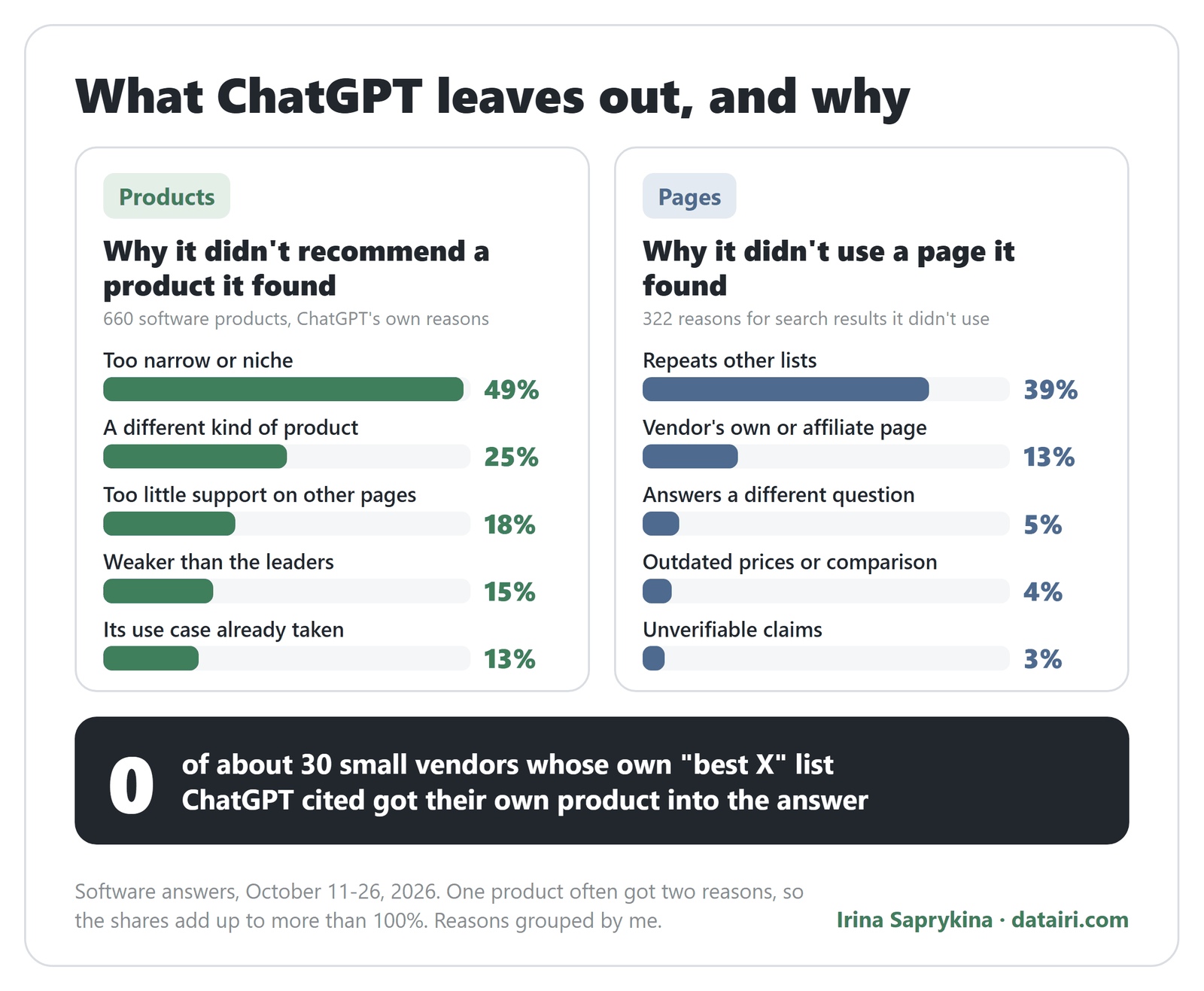
If you ask in the same answer, ChatGPT lists the products it saw and left out, with a reason for each. I added to many questions a request for a second table, "Found but not picked": every product it saw on its search result pages but didn't recommend, with a short reason. Across 660 software products in these tables, the reasons fell into a few groups. One product often got two reasons, so the shares add up to more than 100%:
| Why ChatGPT left the product out | Share of products | Example in ChatGPT's words |
|---|---|---|
| Too narrow, niche or a special case | 49% | Tabnine: "for strict enterprise privacy" |
| A different kind of product | 25% | "Primarily cold sales outreach" |
| Too little support across the other search results | 18% | "Less cross-source support" |
| Weaker than the leaders in its niche | 15% | Launch Fast, #1 on one list: "less established as a default recommendation" |
| Its use case already taken by a product it picked | 13% | OpenAI Codex: "Copilot took the bundled slot" |
| Price | 3% | Rocket French: "a larger upfront financial commitment" |
| Outdated, discontinued or renamed | 2% | Sora: "standalone service reportedly discontinued"; Windsurf, renamed Devin Desktop: "its changing branding and product direction complicate the choice" (one case) |
| The site's own product | 2% | 360 French Immersion, #1 on its maker's own list: "also promoted by its own creator in the article" |
Newer pages could override memory: ChatGPT knew Sora well but left it out of all 11 AI video generator answers, because newer pages among its results said the standalone service had been discontinued.
ChatGPT Uses Vendors' Own "Best X" Lists, but Not to Pick the Vendor
When a software company publishes its own "best X" list with its product on it, ChatGPT uses the page as a source for the other products and leaves the company's own product out.
- Of about 30 small vendors whose list ChatGPT cited, none got its own product into the same answer. Where the product stood on its own list made no difference: first, in the middle or last.
- Well-known vendors' products did appear in the same answers, for about 20 vendors, among them Buffer, Jotform and ClickUp, but by ChatGPT's own account mostly from other pages and its own memory, not from their own lists. That is why the rule shows most clearly for small vendors.
- The rule held when I repeated one question many times. In 20 answers about AI code review tools, one vendor's product was left out every time, although the vendor's own page put it first in a benchmark. ChatGPT's explanation: "#12 is its own vendor page".
The Main Reasons ChatGPT Doesn't Use a Page It Found
In some answers I also asked ChatGPT to mark every search result as "used for picks", "used for facts" or "not used", with a reason for each unused one. Across 322 reasons it gave for pages from sites other than the vendors' in software questions, the most common were:
- Repeating other lists (39%). ChatGPT's explanations: "largely duplicated the main shortlist", "substantially overlaps with other comparisons".
- A vendor's own or affiliate page (13%). ChatGPT's explanation: "affiliate-oriented comparison". In two SEO tool questions (SERP APIs, log file analyzers), 10 of the 17 unused results were vendor pages.
- Other reasons:
- answering a different question (5%);
- outdated prices or older comparisons (4%);
- unverifiable claims (3%), in ChatGPT's words "unusual testing claims could not be independently confirmed";
- secondary write-ups without hands-on testing (3%);
- lookalikes of known sites (2%);
- not an established tester, as for some password manager pages;
- lists with paid placements, in ChatGPT's words "the publisher discloses paid placement";
- copies of the same article on several sites, and pages by the same author, counted as one source, in ChatGPT's words "lower weight because of overlapping authorship".
The rest, about 30%, were vaguer, often only that a page had been used to confirm the other lists. The reasons are not stable, though: the same site was "not used, vendor-authored" in one answer and "used for picks" in the next. In short, once several lists agree, a page that repeats them adds nothing new and is skipped.
A paid first place can still bring a product into ChatGPT's answer. ChatGPT gives less weight to rankings from sites that sell places, but a product such pages put first still got in through them:
- Zonka Feedback, a survey tool ChatGPT didn't name from memory, got into the answers whenever two pages that put it first came up: a site that sells placements, and a page saying Zonka Feedback paid to be included.
- Zoho Social got into social media tool answers on a "best overall" verdict from a site that sells places.
- HubSpot came first in 4 of 5 CRM answers, and ChatGPT's explanation was "Ranked #1 by iTechGuides", a directory that sells ranking positions.
Blocking does not explain the skips. I checked the robots.txt files of the skipped and the picked vendors: all of them allow OpenAI's search crawler.
Stage 8: Which Product ChatGPT Puts First
I checked first place in fewer categories than the other findings in this article, so the points below are observations rather than proven rules.
What decided which product came first:
- The leader of the search results, in about half the categories. In 4 of the 7 categories where I predicted the answers in advance, the product that most pages named and put first came first in 40 of 41 answers: DocuSign, SurveyMonkey, DaVinci Resolve and Gamma. In the other 3 it did not.
- A preference for the small buyer. When the most named products were premium tools, the real answers put the small-business favourite first: Buffer for social media tools, "for most individuals and small businesses". Based on one category.
- A hands-on test. One page that tested the products by hand could decide first place: Brevo came first in 8 of 10 answers to one email marketing query because a site that tested 11 email tools ranked it best overall.
- Below first place, the same order each time. With the same search results, the order hardly changed, for example the first 7 survey tools in all 3 answers. The products with the broadest support came first, add-ons and niche options last.
None of the rules I wrote from the pages predicted first place reliably in the next categories, so ChatGPT probably weighs the pages by rules of its own that these observations don't capture.
Why ChatGPT's List Changes from One Answer to the Next
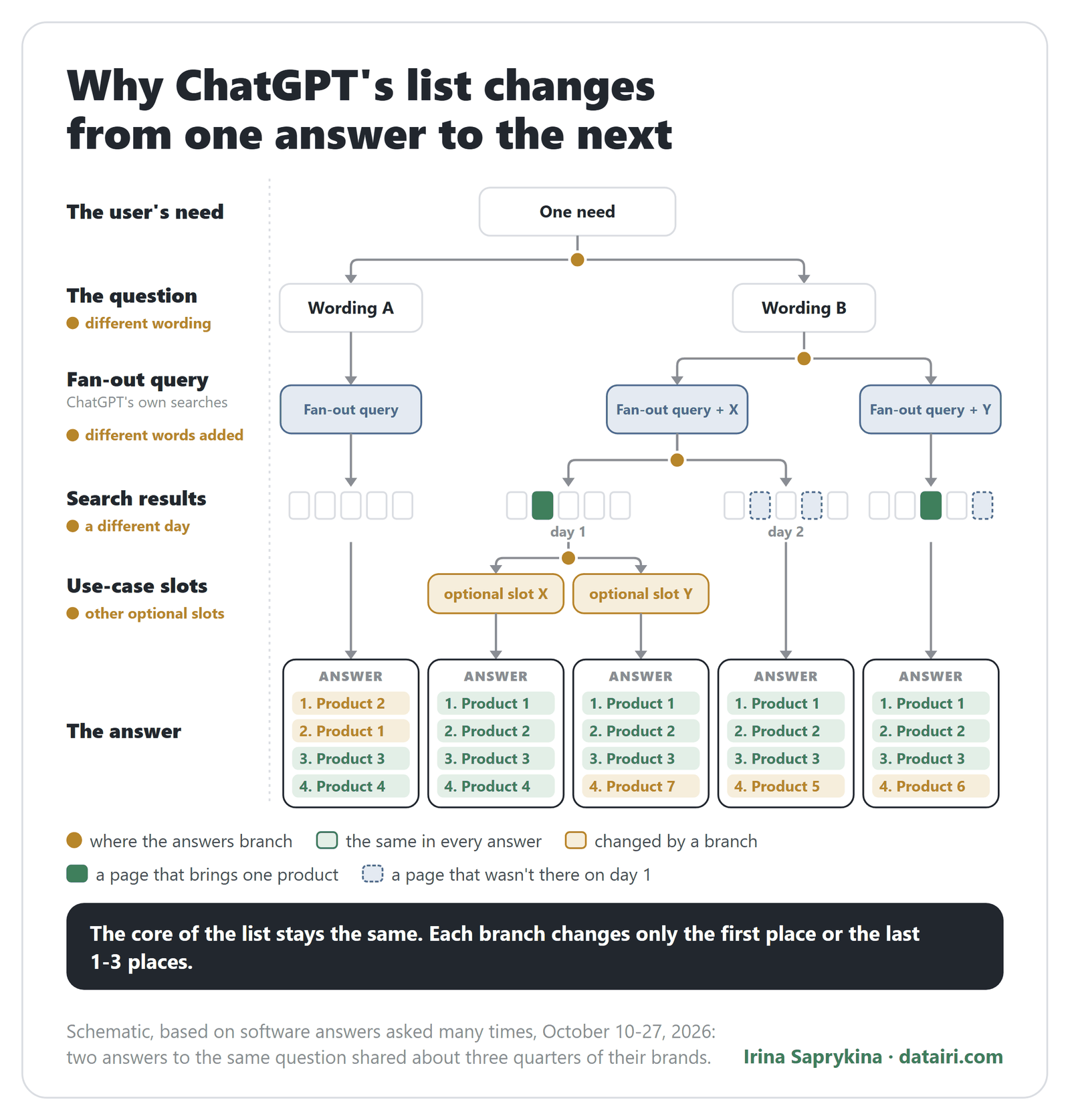
Asked the same question again, ChatGPT recommends mostly the same products, and the differences sit at the end of the list. Across 52 software questions asked normally at least twice, two answers to the same question shared about three quarters of their brands; on average about 1 brand of one answer was missing from the other. In 11 repeats of one fixed AI code review query, all searches returned the same 12 pages, the same five tools were in every answer, and only the last 1-3 places changed. Even in a fast-moving category, AI video generators, the same 7 products were in all 11 answers, with Google Veo first every time. I found five reasons for the changes at the end of the list.
1. ChatGPT words its search query a little differently each time, and the extra words bring in different pages. In 9 answers to the same AI code review question, the words ChatGPT added to its query brought in different pages, and those pages decided the optional places, for example Claude Code Review and Semgrep (more).
2. ChatGPT's search results change from day to day. I asked six software questions with the instruction to search without product names and asked them again a day later. Between the two days, 2-6 of the 11-12 results were different pages, and in form builders more than half of the 18 results were new. The new pages mostly recommended the same products as the ones they replaced, so the picks changed by only 0-2 products per list, and the top pick stayed the same in 4 of 6 questions. Rarely, the search goes to Google instead: once in 12 searches for the same fixed email marketing query, and those results were other pages.
3. A product that rests on a single page's verdict comes and goes with that page. Products in the last places often got in because one page gave them a verdict no other page had, so they were in the answer only when that page was among the results (more):
- Higgsfield was picked in exactly the 2 AI video generator answers whose results included a small site's page that named it the best for camera control.
- Teamwork.com got into a project management answer as the pick for agencies on the day a page recommending it for agencies came up; a day earlier, that page was not among the results, and Teamwork.com was not in the answer.
- Kodus, an AI code review tool that only one page ranked first, was in all 4 answers where that page was among the top three results and gone the one time the page dropped to fifth (one of only two such observations).
4. Even with the same pages, ChatGPT rotates the optional use cases. Each category has a menu of use cases, such as e-commerce, a budget pick or creators in email marketing. In email marketing and project management, each answer used 5-8 use cases from the menu: the central ones almost every time, the others in rotation. In the 11 fixed-query AI code review answers, all 11 searches returned the same 12 pages, yet the last places went to different tools: PR-Agent, SonarQube, Bito, Cursor Bugbot or Snyk Code. The product holding each use case never changed; what changed was which optional use cases made it into the list.
5. Different wording of the same need changes the first place. Asked about a use case in the words of a "best for" label, ChatGPT put the product holding that label first in 8 of 10 answers; asked in everyday words, in 3 of 10, for example Linear instead of Jira for a team that works in two-week sprints (more).
So the core of the list is hard to move, and the last places are where a product can get in or drop out. The core rests on many pages that agree and on ChatGPT's memory, so a few pages coming or going doesn't change it. A place at the end of the list often rests on one page's verdict, so a product there depends on that page being among ChatGPT's results that day, for the words ChatGPT happened to add to its query.
Can You Predict What ChatGPT Will Recommend from Its Search Results?
Predictions made from ChatGPT's own search results, saved before asking, got the core of the list right. I took 7 new categories in two rounds: social media management tools, e-signature software and online survey tools (October 24-26), then CRM software, video editing software, AI presentation makers and online course platforms (October 26-27). For each category:
- I had ChatGPT run one search and only list its results, with the products each page names, without recommending anything itself.
- From that list I wrote a prediction of what ChatGPT would recommend, applying the patterns described in the stages above, and saved it with a timestamp.
-
Then I asked the real questions in new temporary chats and compared the answers with the prediction: 73 answers in total (more).
-
Predicting which products ChatGPT recommends, and for which use cases
- Every product I predicted as certain was in all 29 answers of the first 3 categories, and the products I had predicted would be left out appeared only once in those 29 answers.
- The use cases went to the products I had predicted in almost every case, for example SignWell as the best value for freelancers and small businesses, and Typeform for engaging, conversational surveys.
- In 3 of the other 4 categories, the predictions from the pages were at least as close to the answers as ChatGPT's own list from memory. In online course platforms they were not, because ChatGPT read the question differently from most of the pages.
- The misses were at the end of the list: products that only one page picked for a use case got in more often than I expected. I put Kdenlive and Bigin at 20%, and each got into 4-5 of 5 answers to one query.
- Predicting the order of the products
- The product that most pages named and put first came first in 4 of the 7 categories. In the other 3, my predictions of first place failed (more).
- Below first place, the products with the broadest support across the pages came first, and add-ons and niche options last. With the same search results, the order hardly changed from one answer to the next.
Google's top "best X" articles caught only 58% of ChatGPT's software picks, about two thirds with recent pages. ChatGPT searches OpenAI's own index, which has no public search, so Google's top articles are the closest public stand-in.
For 15 software categories, before asking ChatGPT, I took the 6 products that most of Google's top 10 "best X" articles name. Of the 84 products ChatGPT then recommended, 49 (58%) were on these lists. A week later I repeated the check with pages from the last 3 or 6 months only:
| Google pages used | ChatGPT's picks among the 6 products most pages name | Among the 15 most named |
|---|---|---|
| All dates | 45 of 79 (57%) | 61 of 79 (77%) |
| Last 6 months | 52 of 79 (66%) | 64 of 79 (81%) |
| Last 3 months | 51 of 79 (65%) | 68 of 79 (86%) |
- Recent pages caught about 9 percentage points more of ChatGPT's picks, from 57% to 65-66%. They helped most in email marketing, VPNs and screen recording, and hurt where few recent pages exist, such as budgeting apps. Part of the gain is cleaner data: the date filter also drops undated pages such as app store listings.
- The other patterns from ChatGPT's own results didn't help on Google's pages, such as counting each publisher once or ignoring a vendor's own product on its own list. Google's top 10 had few vendor pages, repeated sites or paid directories for them to act on.
ChatGPT's recommendations differ from Google's top articles in four ways. These explain most of the picks that the articles miss:
- ChatGPT groups its picks by use case: 2-4 general leaders plus one leader per use case, such as Klaviyo "best for ecommerce", Kit "best for creators" or Microsoft Defender "best free antivirus". In its own results, such a place is often filled by one page that gives a product a verdict no other page has.
- ChatGPT leaves out some long-established products that almost every article lists: Constant Contact and GetResponse, Evernote, Bluehost, Rosetta Stone.
- ChatGPT adds newer tools that hardly any article lists, such as Rize, Screen Studio and Quo, plus Apple's own apps.
- ChatGPT uses current product names. Articles still list ConvertKit and OpenPhone, ChatGPT recommends Kit and Quo.
What It Means for Getting Recommended by ChatGPT
The points below are implications of what I saw, not proven rules.
- For software, be on many of the general "best X" lists, high up within each list. ChatGPT's memory reflects what these lists agree on, and when it searches, it picks the products most of its result pages name, almost always from the first few thousand characters of each page. How high the page itself ranks in ChatGPT's search results matters much less.
- A product named by 8 or more of ChatGPT's search results was picked 85% of the time, one named by a single result never.
- Google's top 10 is only a public stand-in for that consensus: 77-86% of ChatGPT's software picks were among the 15 products that Google's top "best X" articles list most often. ChatGPT reads its own search results, and in narrow niches, small sites with a Domain Rating close to 0 shaped its picks.
- Be on recently published or regularly updated lists. ChatGPT's search results lean fresh: the "best X" pages it found were a median 63 days old, against 95 days in Google's top 10, and the pages it cited were a median 29 days old. On Google's side too, keeping only pages from the last 3-6 months caught about 9 percentage points more of ChatGPT's picks. Newer pages can even override what ChatGPT knows: it left out Sora, which it knew well, because newer pages said the service had been discontinued.
- Get a broad "best for" verdict on at least two independent pages.
- If few lists name you yet, get one page with specific evidence. A hands-on test that picks your product for a use case no other product holds, or user ratings with numbers, brought products into ChatGPT's answers from a single page, including GenSpark, which wasn't in its memory at all.
- Aim for a use case no product holds yet. Taking a use case from its holder almost never happened; a broad need without a fixed holder, with a page that names you for it, did work.
- Get a clear "best for
" label on those lists. ChatGPT mostly copies use-case labels from one general list near the top of its results, and a question asked in the label's own words usually gets the label holder first. Asked in everyday words, it put the label holder first only 3 of 10 times, so a label helps with questions worded like the label, not with every question about that use case. - To come first, be the product most independent pages name and call good value and best overall. ChatGPT gave exactly these reasons when it ranked products without their names. The product that most pages named and put first came first in 4 of the 7 categories I predicted.
- Expect a name ChatGPT doesn't know to need more page support than a known one. With the same evidence, a known brand got into the list and an unknown one was pushed down or out.
- Don't count on your own "best X" page to recommend you. ChatGPT uses vendors' lists to find other products and skips the vendor's own. To be recommended, you need to be on other people's lists.
- Check what your category name means to ChatGPT. Ask it, without search, which products it would recommend. If it names a different kind of product, its answers will be about that kind first, whatever the search results say. This rests on one category so far.
- Remember that which pages ChatGPT gets depends on the query. The same product can be in one kind of answer and missing from another.
- Make your product easy to check. ChatGPT checks its picks on the vendors' own sites, mainly for prices, so keep pricing and feature pages current and accessible. If you renamed the product, keep the old name visible. This rests on a single observation: ChatGPT skipped one renamed tool because of its "changing branding".
- For hardware, get tested by the testers ChatGPT searches for (from fewer questions than the software findings). RTINGS, Wirecutter, Tom's Guide and category specialists are named in its first search, and their current picks are close to its answer.
Hardware and Other Categories
Most of this study is about software, apps and online services: most questions and almost all the repeated tests were in these categories. Hardware and other products got fewer questions, and they behaved differently enough to keep them apart.
For hardware, ChatGPT's first search names testers, not products. Only 17 of 86 brands in the hardware answers (20%; 29% with each question counted once) were already in the first search. Instead it named the sites it wanted to search on: "best robot vacuums 2026 tested Vacuum Wars RTINGS Wirecutter October 2026".
For hardware, the testers' current picks predicted ChatGPT's list. In 5 hardware categories, the current picks of RTINGS and Tom's Guide predicted all 13 brands ChatGPT recommended, and 19 of its 21 models. Unlike software, there was no gap of older or newer products: the answer follows a few testers whose picks are current.
For robot vacuums, the one hardware category I repeated many times, the testers' awards made the list. On October 23 I asked about robot vacuums 12 times: 8 times with the fixed query "best robot vacuum 2026" and 4 times with ChatGPT's own query.
- The fixed query returned only testers. All 8 searches got the same 8 pages from TechRadar, Vacuum Wars, RTINGS, WIRED, Good Housekeeping and Tom's Guide, with no small lists and no vendors. The same four models were in all 8 answers, which named 5-8 models each, and ChatGPT added none from memory: "None of the five were added independently of these search results." In software categories such as email marketing, a large share of its reasons was its own knowledge.
- Each place was one tester's award. The value pick was Vacuum Wars' best value, the budget pick Tom's Guide's choice under $300, the lab leader Vacuum Wars' #1. First place, Roborock Qrevo Curv in 7 of 8 answers, was the model that two testers backed, TechRadar as best overall and RTINGS, while the guides named six different models as best overall.
- ChatGPT's own query brought other testers and a different first place. It added "tested" or "reviews" to its query, and lab pages moved up while TechRadar's guide fell to #5-#10 or disappeared. MOVA V70 Ultra Complete, Vacuum Wars' lab winner, came first in all 4 answers, and the Qrevo Curv made the list only once.
- Testers behind a paywall added nothing. Which? and Consumer Reports were among the results, but their winners were for members only, so neither shaped a pick.
Searching without brand names changed the robot vacuum list more than any software list: 5 of the 9 brands of the normal answer were missing from the answer without brand names.
Other topics had only a few questions each. The start looked the same as for software: ChatGPT began from what it already knew. For meal kits, about half the brands it recommended were already in its first search. For accounting software in Serbia, 2 of the 4 local brands it recommended were already in its first search. Pages about mattresses and running shoes were mostly left out for answering a different question.
How Sure These Findings Are
- Most of the findings come from one account, one model and temporary chats. Almost all answers came from one ChatGPT Plus account, the
gpt-6-thinkingmodel and temporary, unpersonalized chats. Checks on the fastergpt-6model, on a new free account and in my own long-used account gave the same picture (details in the Method section). -
Much of the reasoning comes from ChatGPT's own tables. In many answers I asked ChatGPT to add tables in the same answer: which search results named each product, why it left a product or a page out, where a label came from. These are its self-reports. The places it claimed matched the pages every time I could check, but its reasons were not always stable.
Two things speak for these self-reports: the same logic showed up across very different software categories, and predictions built on that logic, saved before asking, matched ChatGPT's real recommendations fairly closely. - Asking for such a table can change the answer. For online course platforms, adding a table of the pages behind each pick put the other kind of platform first in 3 of 3 answers and dropped products that only one page supported. For CRM and video editing, the picks with this table were the same as without it. Asking for the table also made ChatGPT open pages more often: at least one page in 110 of 166 answers with a table (66%), against 32 of 246 without one (13%). - The samples per category are small. Most categories got one or two answers per question; repeats of 4-12 answers to one question were run for AI code review, email marketing, project management, robot vacuums and AI video generators, and 9-11 answers per category in the seven prediction tests. - The process was reconstructed mainly from software, apps and online services. Hardware and other products had fewer questions (more). - Single observations are marked as such in the text: the renamed tool, the effect of a page's rank on whether one product got in, and what "online course platforms" means to ChatGPT.
The full list of limitations is in the Method section.
Method
Which data each finding rests on:
| Test | Dates (2026) | Sample | Used in |
|---|---|---|---|
| All "best X" questions | Oct 10-27 | 462 answers, about 135 questions (blind-test runs not counted) | Method; Stage 2 |
| Normal questions, brands in the first search | Oct 10-27 | 187 answers to 95 questions (171 answers to 81 software questions) | Stage 1 |
| Normal vs without brand names | Oct 10-27 | 29 software questions asked both ways; 52 software questions asked normally at least twice | Stage 1 |
| Reasons for left-out products and unused pages | Oct 11-26 | 660 software products; 322 reasons for unused pages from sites other than the vendors' | Stage 7 |
| Repeats with every result per product | Oct 23-26 | 50 answers in 3 software categories, 2,902 products found, 1,846 mentions on pages not opened | Stages 3, 4 and 7 |
| AI code review repeats | Oct 11-23 | 11 fixed-query + 9 own-query answers; 44 answers with use-case labels | Stages 2, 4, 5 and 8 |
| Use-case labels and wording | Oct 20, Oct 23 | 8 general + 14 use-case answers; 10 use cases asked two ways | Stage 6 |
| Predictions from ChatGPT's own results | Oct 24-27 | 7 categories, 73 answers | Stage 8; predictions |
| Blind tests | Oct 26, Oct 29 | 5 categories, 39 runs | Stages 1 and 8 |
| Google consensus | Oct 11-13, Oct 21 | 15 software categories: 84 and 79 recommended products | Predictions |
| Hardware testers and robot vacuum repeats | Oct 12, Oct 23 | 5 categories, 13 brands, 21 models; 12 robot vacuum answers | Hardware and Other Categories |
| Other settings and my own account | Oct 23, Oct 25 | 6 questions on two other settings; 9 answers in my own account | Limitations |
How I Collected the Data
Between October 10 and 27, 2026, I asked ChatGPT 462 "best X" questions, about 135 different ones: consumer and B2B software, AI tools, hardware, consumer products, local services and fresh product launches. The first week, 143 answers to 80 questions, showed the main patterns; the later answers repeated many of these questions and tested what I had seen. The main counts use all answers; where a count comes from one test or one week only, the text says so. Almost all answers (448 of 462) came from one ChatGPT Plus account and the gpt-6-thinking model (the "Medium" setting), and 417 came from temporary, unpersonalized chats, so earlier conversations and my settings could not influence them. The others were checks on other settings, described in the limitations below. Not counted here are 39 runs of the blind test, in which I pasted result pages with the product names hidden and ChatGPT did not search. Most questions were asked from Serbia, one prediction round through a US VPN.
For every answer I saved the conversation's raw data from the ChatGPT web app, captured with a script in my browser. It includes what the chat window doesn't show: the search queries ChatGPT ran, every search result it got, and the brands it marked in its answer.
How I Asked ChatGPT Where Each Product Came From
From October 15 on, I added a request to many questions: at the end of the answer, a table of where each recommended product came from (the search result, its number in the results and the product's place on that page, or "my own knowledge"). In later runs I also asked for a second table, "Found but not picked", with the other products from the same pages and a short reason for each, and in others for every search result marked "used for picks", "used for facts" or "not used", with a reason. From October 22, the repeats asked for every result that named each product, picked or not.
This has to be asked in the same answer. In a follow-up message, ChatGPT no longer sees the search results of its previous answer: it either says it "cannot verify" or runs a new search.
The tables are accurate about places. I fetched the pages ChatGPT named and compared its claims with the page's own list: across about 60 claimed positions, picked and not picked, none was wrong. The "best for" labels held up too: of the 28 quoted labels on pages I could read, 19 stood word for word on one site only, the one ChatGPT named.
The first tables asked for the result "where you first saw it", so they credited each product to the highest result that named it and made it look as if ChatGPT went through its results from the top. That is why the counts by number of results use the later tables, which listed every result naming each product.
How the Predictions were Made
I took 7 new categories in two rounds: social media management tools, e-signature software and online survey tools (October 24-26), then CRM software, video editing software, AI presentation makers and online course platforms (October 26-27). For each category, ChatGPT first ran one fixed query, "best
Definitions
- Brands in the answer: the products ChatGPT marks as entities in its answer, matched at vendor level, so "Microsoft OneDrive" and "OneDrive" count as one.
- Brands in the first search: all distinctive words of the brand name appear in the queries of ChatGPT's first search call. Counted once over all answers and once with each question weighted equally, because some questions were asked many times.
- Normal vs without brand names: each normal answer compared with each answer to the same question with the instruction to search without product names; the same comparison between two normal answers gives the variation of a plain repeat.
- Google consensus: the products used as headings on at least two of the pages in Google's top 10 for "best X" and "best X 2026" (US, English, via DataForSEO), ranked by the number of pages, first 6. Hardware: the current picks of the RTINGS and Tom's Guide "best" pages.
- Blind test: the result pages of five categories, as ChatGPT's own listings had summarised them, with every product name replaced by a code, pasted into new temporary chats with no search, 3-6 runs per category, plus runs where only one product's name was shown or hidden.
Limitations in Full
The main limitations are in How Sure These Findings Are. Beyond those:
- Personal memory. In my own long-used account, 5 questions gave the same picture as the temporary chats, but a product connected to my past work came about three places higher. Memory moved it up but didn't add a product that wasn't on the list anyway.
- Location. Most questions were asked from Serbia. Even in temporary chats, ChatGPT added Serbian job sites and a budgeting app popular in the region; through a US VPN it did not. The Google side was always US results in English.
- Asking for every product found but not picked made ChatGPT open the big directories, sometimes several times in one answer. Without that request it may open fewer pages.
- The same query can return different pages depending on what ChatGPT is asked to do: the prompt that only listed the results and the prompt that asked for recommendations often got different pages. This is one reason the predictions missed at the end of the list.
- The blind tests used ChatGPT's summaries of the pages, not the full pages, so evidence the summaries left out, such as review ratings or prices, was missing.
- Pages were fetched by me, on the same day or up to two weeks later, and pages change. Products on a page are read from its headings, so a few counts are approximate. In the mention counts, 588 mentions were no longer on the page and 433 pages blocked automated access; both are left out.
- Page age comes from the dates the pages declare (modified or published), counted from the day of the answer. 28-37% of the pages declared no date, and many sites refresh the date without changing the list.
Sources
My earlier articles this study builds on:
- Two Ways ChatGPT Searches the Web: how to tell OpenAI's own index from Google in ChatGPT's search results.
- Google or ChatGPT's Own Index: When ChatGPT Uses Which: when ChatGPT turns to Google.
Data and tools:
- ChatGPT conversation data, saved from the ChatGPT web app with my own browser script. FanoutFox, a free Chrome extension, helped me figure out where to look for the search queries in the data my browser receives from ChatGPT.
- Google search results (US, English, top 10) via DataForSEO.
- Domain Rating and organic traffic from Ahrefs.

I'm Irina Saprykina, and I've worked in SEO and digital marketing since 2006, mostly in-house, promoting international SaaS companies. I'm a mathematician by training, which is probably why I'd rather test and automate a process than take a claim on faith. datairi is where I publish those experiments and the tools that come out of them.